







Tomato Companion Plants: What Actually Works (Especially in a Pot)
Search for tomato companion plants and you will find a hundred charts that all disagree with each other. Plant marigolds. Never plant fennel. Basil makes them sweeter. Somebody's grandmother said so, and now it is on the internet forever.
We went and read what university researchers actually found. Some of the famous advice holds up. Some of it really does not. And almost none of it was written for someone growing a tomato in a pot on a balcony. Which is where most of us are.
So here is the useful version. What to plant with your tomato, what it really does, and what matters more.

The short list: good tomato companions
| Plant | What it really does |
|---|---|
| Marigold | Real peer-reviewed research behind it, with one condition that a grow kit happens to meet. See below. |
| Basil | Shares the same water and light needs. Its flowers pull in bumblebees, and tomatoes are pollinated by bumblebee buzzing. Good roommate, great on a plate. |
| Cilantro and parsley | Let them flower and they bring in the small beneficial insects that eat aphids. |
| Nasturtium | A genuine aphid trap crop, but it needs space and a head start to work. |
| Chives and calendula | Widely recommended, pleasant to grow, no solid research behind the pest claims. |
Notice the pattern. The companions worth your pot space are the ones that either feed you, feed pollinators, or want the same watering can.
The marigold question, answered properly
Everybody repeats the same line: plant a marigold next to your tomato and it stops nematodes. The real story is more interesting, and it lands in your favor.
Start with what the research supports. A 2019 study in PLOS ONE found French marigolds grown alongside tomatoes cut greenhouse whitefly numbers. The researchers found the mechanism too. Marigolds release limonene into the air, and whiteflies want nothing to do with it.
Then came the condition that decides everything. The marigolds had to go in at the start, together with the tomato. Bringing them in later, once whiteflies had already arrived, barely moved the needle.
That is the useful part. The version that works is the one where both plants start on the same day. Which is exactly what happens when you sow a kit with both seeds in it. You are setting it up right from the first watering instead of patching a problem in July.
The Royal Horticultural Society adds a good footnote: mixing tomatoes with other plants helps even without marigolds. One more argument for the two-plant pot over the lonely single crop.
The nematode claim is a different pest and a different method. Those studies use a solid block of marigolds grown all season and then tilled into garden soil. That is a field technique. Good news if you grow in pots: fresh potting mix does not carry those nematodes anyway, so it is not a problem you need to solve.
Tomato and marigold also want identical conditions. Both go in a quarter inch deep, both germinate in 7 to 14 days, both want 70 degrees and full sun. That is why they share a planter so well, and why our Tomato and Marigold kit puts them in one. Two seeds, one afternoon, both up inside two weeks.
Does basil belong next to your tomato?
Yes, and for better reasons than the one everybody gives.
The famous claim is that basil makes tomatoes taste sweeter. Someone finally tested it. A West Virginia University study ran double-blind taste tests for three years and found no consistent flavor difference.
The same study found something more useful. Growing tomato and basil together at high density raised yield by about twenty percent. More tomatoes from the same windowsill, which is the whole game in a small space.
There is a second reason, and it is the one we like. Tomatoes are pollinated by bumblebees, which grab the flower and shake the pollen loose. Basil flowers bring those bumblebees in. Let a few basil heads open and you are helping your tomato set fruit.
So yes to basil. Yield and pollination beat a flavor legend anyway.

What not to plant near tomatoes
One of these is serious. The rest are tradition.
Black walnut. This one is real. Walnut roots release juglone, and Kansas State Extension names tomatoes as particularly sensitive. Leaves yellow, twist and pucker. A sensitive plant can go from healthy to dead in a week or two. The affected zone reaches fifty to sixty feet from a mature trunk, sometimes eighty. If you have a black walnut, grow your tomatoes somewhere else.
Potatoes. Both are in the nightshade family and both host early blight and late blight. University of Minnesota Extension's guidance is about soil and time: wait two years before planting tomatoes where the family grew before. It is a rotation rule more than a spacing rule.
Cabbage family and fennel. These appear on almost every avoid list, including Cornell's. Neither Cornell nor West Virginia Extension gives a reason or a study. Treat it as garden tradition. Skip it if you like, and know that nobody has shown why.
On the charts themselves, Washington State University Extension does not hedge. They say there is no scientific basis for any of the several compatibility lists in circulation, and that their value is entertainment.
In a pot, the rules change
This is the part the charts never mention, and it matters most to us.
Trap cropping needs room. Washington State's own instructions describe a border planting that pests can choose to land on instead. A nasturtium four inches from your tomato is not an alternative destination.
What does carry over to a pot is simpler and more important: two plants in one container fight over water and root space. Your tomato needs eight to ten gallons of growing medium and twelve to sixteen inches of depth, per University of Maryland Extension. Basil on its own wants one to three gallons. Put both in a ten gallon pot and neither gets what it was measured for.
And some pairings are a straight mismatch. Rosemary, thyme, sage and oregano want to dry out between waterings. A container tomato in July can need water twice a day. Those two plants cannot share a pot and both be happy. Basil and cilantro drink like a tomato does, so those are the herbs to put beside it.
Pot sizes that actually work
| Setup | What you need |
|---|---|
| One determinate (bushy) tomato | 5 gallons is workable, bigger is better |
| One indeterminate (vining) tomato | 8 to 10 gallons, 12 to 16 inches deep |
| Tomato plus a basil in the same pot | Larger than the tomato's own minimum, or the basil is just competition |
| Herbs on their own | 1 to 3 gallons each |
The tidiest answer for a small space is to give each plant its own root space while they share the same sunshine and the same watering round. Two pots side by side does it. So does a windowsill planter with separate growing sections, which is exactly how our kit instructions tell you to sow: one variety per section.

Three things that matter more than any companion
- Sunlight. Six hours of direct sun is the floor. Eight to ten is where tomatoes get good. Three separate extension services land on the same numbers.
- Steady water. One to one and a half inches a week, evenly. Not a drought then a flood.
- That second point again, because of blossom end rot. Those sunken brown patches on the bottom of a tomato are almost always a watering story. Oregon State Extension describes it as a physiological disorder from water and nutrient imbalance, not a disease you catch. Consistent moisture prevents it. University of Maryland suggests a quarter cup of gypsum mixed into the planting hole as insurance.
Get those three right and you will out-grow anyone with a perfect companion chart and an erratic watering can.
Where to start
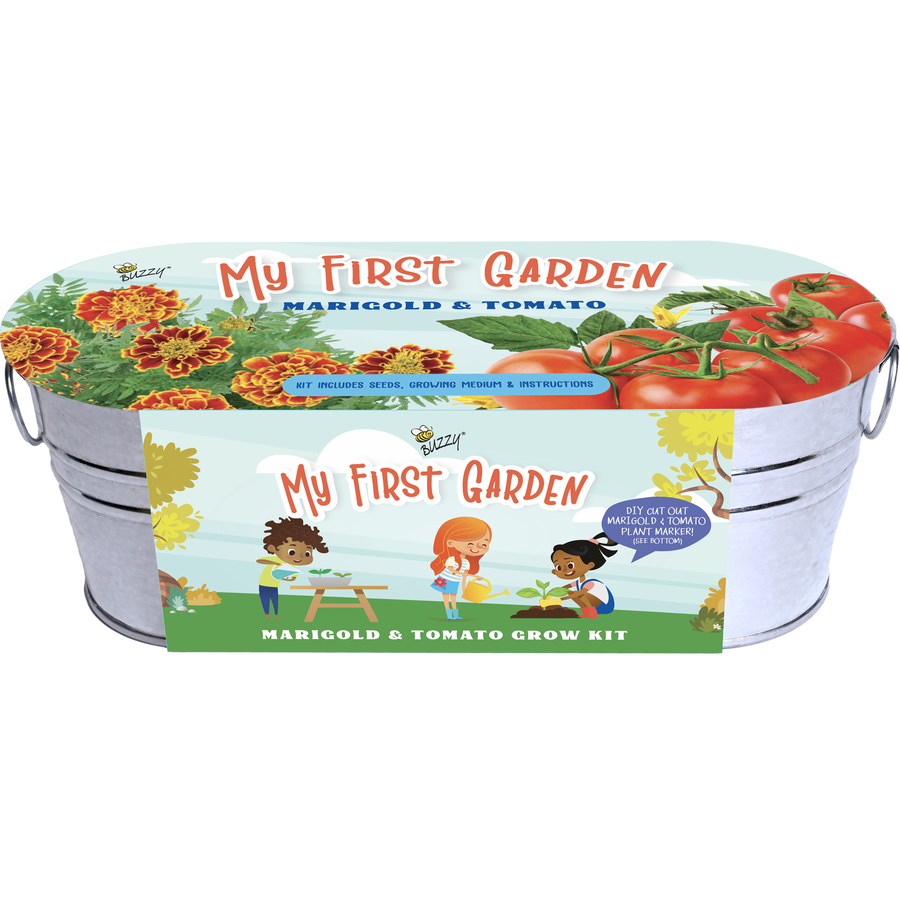
- Kids My First Garden, Tomato and Marigold. Both seeds sown the same day in separate sections, up in 7 to 14 days. The pairing the whitefly research actually supports.
- Taco Night Grow Kit. Tomato and cilantro, which is the companion pairing that actually ends up on a plate together.
- Organic Kitchen Herbs. Basil, cilantro and chives for the pot next door.
- Self-Watering Tomato Planter. Trellis and reservoir built in, for when you want the tomato to go the distance.
Start your seeds indoors in late winter and you will have seedlings ready when the weather turns. Every Buzzy kit comes with our Guaranteed to Grow promise, so if nothing comes up we will replace the seed packet for free.
Keep reading
How to Grow Basil from Seed (Step-by-Step for Beginners) · 10 Classroom Garden Ideas for Back-to-School · Summer is Winding Down. Your Herb Garden Doesn't Have To · 7 Best Indoor Herb Garden Kits for Small Apartments
Sources
- Buzzy Seeds Kids My First Garden Grow Kit (kit instructions, germination times and sowing depth)
- Conboy et al., PLOS ONE 2019 (French marigold limonene reduces glasshouse whitefly on tomato, when planted from the start)
- UC Statewide IPM Program, Nematodes Pest Notes (the nematode method needs a season-long solid planting)
- Clemson Cooperative Extension, Root-Knot Nematodes in the Vegetable Garden
- Royal Horticultural Society, Companion Planting (mixed planting helps even without marigold)
- West Virginia University Research Repository (three years of double-blind taste tests, plus the 20 percent yield finding)
- UC Marin Master Gardeners (tomatoes need buzz pollination from bumblebees)
- Washington State University Extension, Trap Cropping (conditions for nasturtium trap crops)
- K-State Research and Extension, Landscaping Near Black Walnut Trees (juglone, tomato sensitivity, 50 to 80 foot zone)
- University of Minnesota Extension, Early Blight of Tomato and Potato (two year rotation)
- University of Maryland Extension, Containers for Growing Vegetables (8 to 10 gallons, 12 to 16 inch depth)
- University of Wisconsin Extension, Tomatoes in Containers (determinate vs indeterminate, twice-daily watering)
- Oregon State University Extension, Blossom End Rot in Tomatoes
- Penn State Extension, Tomatoes from Seedlings to Fruit (six hours minimum sun, 1 to 1.5 inches water weekly)